

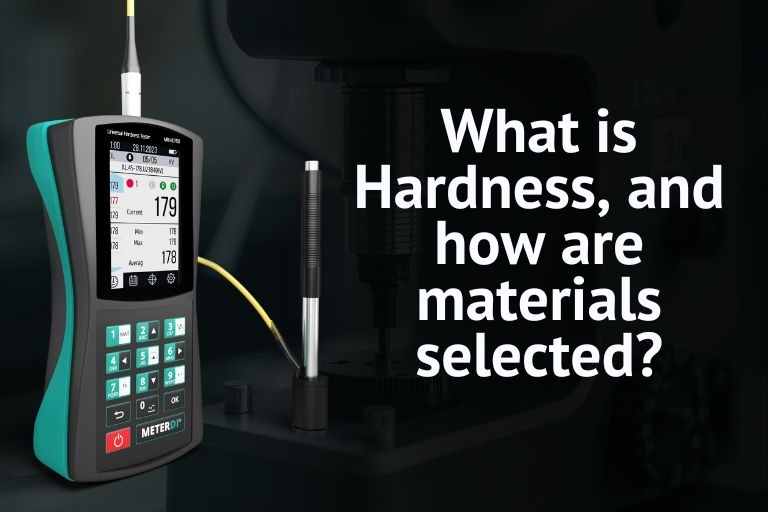
What is Hardness, and how are materials selected?
Hardness is the property of a material by which the material resists penetration.

How are materials selected?
For any purpose or application, when selecting the right material or determining its condition, the following properties are considered.
- Physical Properties
- Chemical Properties
- Mechanical Properties
Physical Properties
Physical Properties is a properties that identify the outer structure or state of a material. These properties help determine in which environment a material can be used, such as in heat, cold, or humidity.
Main Physical Properties
- Density: Indicates how heavy the material is.
- Melting Point: The temperature at which the material melts.
- Electrical Conductivity: How well the material conducts electricity.
- Thermal Conductivity: How efficiently the material transfers heat.
- Color: It indicates the color of the material.
- Boiling and Melting Points
- Shape: Indicates what is the shape of the material.
Examples:
- Copper is a good conductor of electricity, so it is used in wiring.
- Aluminium is lightweight, making it suitable for the aerospace industry.
Chemical Properties
Main Chemical Properties
- Corrosion Resistance
- Oxidation Resistance
- Acid/Alkali Resistance
Mechanical Properties
In mechanical properties, it tells how a material behaves under extra force or pressure. Means that how is the hardness, tensile strength, elasticity, ductility, or toughness of a material.
Use in Industry:
When making machine parts, tools, or structures, materials are selected based on their mechanical properties.
Main Mechanical Properties:
- Hardness → Ability to resist pressure or wear.
- Tensile Strength → The limit before the material breaks when pulled.
- Elasticity → Ability to return to its original shape after removing the force.
- Ductility → Ability to be drawn into wires.
- Toughness → Ability to withstand twisting or sudden impact.
Examples:
- Steel is hard and strong, so it is used in machine shafts and gears.
- Aluminium is light and somewhat flexible, so it is used in aircraft bodies.