
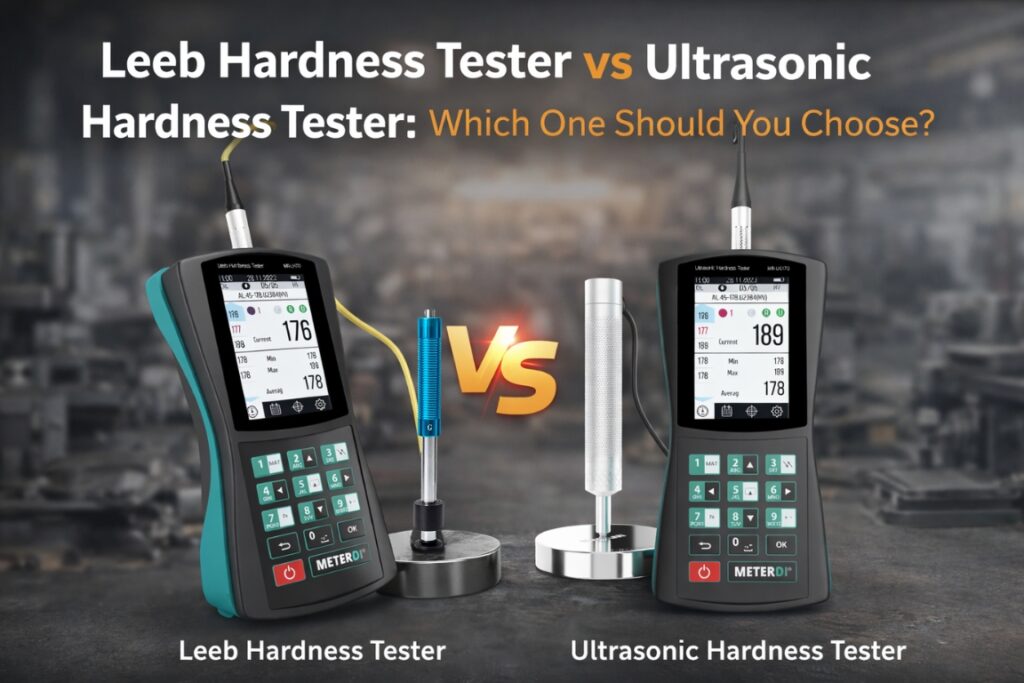
Leeb Hardness Tester vs Ultrasonic Hardness Tester: Which One Should You Choose?
When it comes to portable metal hardness testing, two technologies dominate the market — Leeb Hardness Tester and Ultrasonic Hardness Tester (UCI). Both are widely used in industries like manufacturing, fabrication, oil & gas, railways, aerospace, and heavy engineering.
If you are planning to invest in a Portable Hardness Tester, this detailed guide will help you understand the difference between Leeb and Ultrasonic hardness testing methods and choose the right solution for your application.
For a complete range of portable models, visit:
👉 https://meterdi.com/product-category/portable-hardness-tester/
What is a Leeb Hardness Tester?
How Leeb Hardness Testing Works:
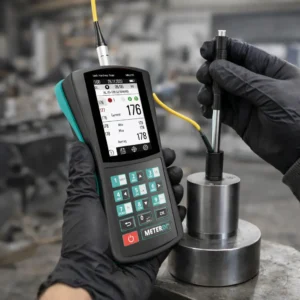
An impact device (usually Type D probe) strikes the test surface.
The rebound velocity is measured.
The hardness value is calculated in HL (Leeb hardness).
The device converts HL into other scales like HRC, HB, and HV.
Best Applications of Leeb Hardness Tester:
Large castings and forgings
Heavy shafts and pipes
Installed machinery
Structural steel
Field inspection jobs
Advantages of Leeb Hardness Tester:
✔ Highly portable
✔ Very fast testing
✔ Ideal for large and heavy components
✔ Minimal surface preparation
✔ Cost-effective solution
If your primary requirement is field testing of heavy components, a Leeb Hardness Tester is usually the best choice.
What is an Ultrasonic Hardness Tester (UCI)?
How Ultrasonic Hardness Testing Works:
A probe with a Vickers diamond indenter is pressed onto the material.
Ultrasonic vibration frequency changes during contact.
The frequency shift is measured.
Hardness is directly calculated, mainly in HV scale.
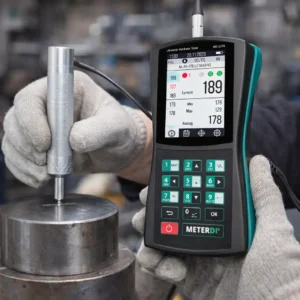
Best Applications of Ultrasonic Hardness Tester:
Thin components
Small precision parts
Weld zones
Heat-affected zones (HAZ)
Gears and complex geometries
Advantages of Ultrasonic Hardness Tester:
✔ High precision measurement
✔ Excellent repeatability
✔ Suitable for thin materials
✔ Ideal for weld inspection
✔ Laboratory and field use
If accuracy on small or thin components is critical, an Ultrasonic Hardness Tester is the better option.
Leeb Hardness Tester vs Ultrasonic Hardness Tester
| Feature | Leeb Hardness Tester | Ultrasonic Hardness Tester |
|---|---|---|
| Working Principle | Rebound method | Ultrasonic Contact Impedance |
| Best For | Large, heavy components | Thin, small, precision parts |
| Surface Requirement | Minimal preparation | Smooth and clean surface required |
| Portability | Very high | High |
| Accuracy | Good for field use | Higher precision |
| Operator Skill | Easy to operate | Requires stable contact |
| Common Scale | HL (convertible) | HV (convertible) |
Which Portable Hardness Tester is Right for You?
Choosing between a Leeb Hardness Tester and an Ultrasonic Hardness Tester depends on:
Component size
Thickness
Accuracy requirement
Industry application
Field or lab usage
Many modern Portable Hardness Testers combine both technologies in one device, allowing you to switch between Leeb and UCI probes as required.
Explore professional-grade models here:
👉 https://meterdi.com/product-category/portable-hardness-tester/
Final Thoughts
Both Leeb Hardness Testers and Ultrasonic Hardness Testers are powerful tools for non-destructive metal hardness testing.
Choose Leeb Hardness Tester for heavy industrial field applications.
Choose Ultrasonic Hardness Tester (UCI) for precision and thin components.
If you are looking for a reliable Portable Hardness Tester for industrial use, make sure to select a device that matches your technical requirements and testing conditions.
For detailed specifications and available models, visit:
👉 https://meterdi.com/product-category/portable-hardness-tester/